
Ben Hogan has one of the greatest records in the U.S. Open, most impressively tied for the most victories with four, discounting the Hale America National Open in 1942, which the USGA doesn't count. Hogan's fourth victory came on June 13, 1953, when he won by six over Sam Snead at Oakmont. During the next seven years, Hogan had finishes of 7th, 2nd, 2nd, 10th, 8th and 9th, but never did win the National Open again.
World Golf Hall of Fame member and onetime U.S. President George H.W. Bush was born on this date in 1924. He shares a birthday with a famous lass from the Quad Cities, Illinois, USA, Mary Schrock. On the golf course, Ben Hogan won his first of four U.S. Opens, at Riviera in Los Angeles, on June 12, 1948, by two shots over Jimmy Demaret.
On June 11, 1938, Ralph Guldahl became the fourth person to win back-to-back U.S. Opens, following Willie Anderson, John McDermott and Bobby Jones to that point. Guldahl shot a 69 at Cherry Hills to finish six shots ahead of Dick Metz. In 1937 he had finished two shots ahead of Sam Snead at Oakland Hills.
Sam Snead, the all-time victory leader on the PGA Tour, infamously never won the U.S. Open, and one of his closest misses took place in 1939, at Philadelphia Country Club. Snead had led after the first two rounds, but on June 10, thinking he needed to be aggressive on the final hole, took a triple-bogey 8 when all he needed was a par 5 to win. He finished two behind Byron Nelson, Craig Wood and Denny Shute, who went on to decide a champion in a playoff. Nelson and Wood were tied after 18 holes, with Shute dropping out, then Nelson eventually prevailed in a second playoff round, 70-73.
Four years after Bobby Jones clinched the Grand Slam at Merion in 1930, the iconic club near Philadelphia was site to its first U.S. Open. It ended on June 9, with Olin Dutra winning by one shot over Gene Sarazen. Dutra shot a 72 in the final round to edge Sarazen, who was looking good with 18 to go but struggled to 76.
The 39th playing of the U.S. Open in 1935 was unlike any other to that point. Finishing on June 8 and played at tough Oakmont (Pa.) Country Club, Sam Parks Jr. was the surprise winner, beating Jimmy Thomson by two and Walter Hagen by three. Parks was a local favorite who played out of South Hills Country Club in nearby Pittsburgh. Prior to the '35 playing, the championship had been dominated by foreign players at first, then American winner Francis Ouimet in 1913 spurred a turnaround by the Yanks. Along came amateur stars Chick Evans and Bobby Jones, plus Hagen and Gene Sarazen. Today the U.S. Open is well-known for, "Unknown leads Open" headlines, but in 1935, that wasn't a catchphrase yet, so Parks' victory was indeed a win for the little guy.
It took seven tries for the British side to win its first Curtis Cup Match but they finally broke through in 1952. It took place at Muirfield, Scotland, which only this spring voted to allow women to become members. The final day was June 7, 1952, and it came down to the final match, where Brit Elizabeth Price beat Grace DeMoss, 3 and 2, to give the British Isles a 5-4 victory.
For the second day in a row, we "observe" a Bobby Jones runner-up finish in the U.S. Open. Jones was 21 when he won in 1923, but on June 6, 1924, a fourth-round 78 allowed Cyril Walker to sneak in to win by three shots at Oakland Hills in Birmingham, Mich. As noted yesterday, June 5, Jones lost in a playoff in 1925, but then he won three of the next five National Opens and lost a playoff in a fourth. From 1920 to 1930, Jones missed the top 10 just one time, and that was by a shot.
Willie MacFarlane forever put himself into golf lore on June 5, 1925, when he defeated Bobby Jones in a 36-hole playoff by one stroke at the U.S. Open at Worcester (Mass.) CC. MacFarlane shot 75-72 to Jones' 75-73. Jones had won in 1923, and would win again in 1926, 1929 and 1930.
A pair of Sandras was born on this date. Sandra Haynie was born in 1943. The World Golf Hall of Famer won 42 LPGA Tour events, including four majors: the 1974 U.S. Women’s Open, 1965 and 1974 LPGA Championship, and 1982 Peter Jackson Classic. Canadian star Sandra Post was born in 1948. She won nine times on tour, including the 1968 LPGA Championship.
On this date in 1945, three-time U.S. Open winner Hale Irwin was born in Joplin, Missouri. Irwin was an excellent football player, but he transferred that toughness onto the golf course and not only excelled in the U.S. Open but was a great player on tough courses in general. Perhaps his greatest display of toughness was winning the Massacre at Winged Foot U.S. Open in 1974 with a 7-over-par score. Irwin was also known for his great play with fairway woods. Irwin went on to set the record for the most Senior PGA Tour victories with 45.
African-American pioneer and World Golf Hall of Fame member Charlie Sifford was born on this date in 1922. He won twice on tour: the 1967 Greater Hartford Open and 1969 Los Angeles Open. His lone major victory was the 1975 PGA Seniors’ Championship. Sifford died on Feb. 3, 2015. Also today, 1982 Masters champion Craig Stadler is 64.
Today’s feat is a hybrid combining baseball and golf. On this date in 1925, the great Iron Horse of baseball, Lou Gehrig, began his streak of 2,130 consecutive games played in a day game against the Washington Senators at Yankee Stadium. Gehrig made an out in pinch-hitting for shortstop Paul (Pee Wee) Wanninger, then started the next day at first base, replacing Wally Pipp, who was in a batting slump. Just 10,000 saw Gehrig’s streak start and the Yankees lose, 5-3. The game only took 1 hour 50 minutes. A PGA Tour equivalent to Gehrig’s streak is Tiger Woods’ record of 141 consecutive events without missing the cut, which went from February 1998 to May 2005.
The PGA Championship is mainly associated with being played in August, but it’s actually been spread throughout the calendar. On this last-day-in-May date in 1949, Sam Snead won the PGA at the Hermitage in Richmond, Va., beating Johnny Palmer, 3 and 2. Snead, “the ageless one,” was 37 years old and had won the Masters earlier in the year. He also won the PGA in 1942 and 1951.
If you count Jim Barnes winning in 1916 and 1919 with the two middle years taken off for World War I, the PGA Championship has been won in consecutive years seven times. Tiger Woods did it twice, and Walter Hagen won not just two in a row but four. On this date in 1937, Denny Shute won his second straight PGA at the Pittsburgh Field Club in Fox Chapel, Pa. He beat Harold (Jug) McSpaden in 37 holes. McSpaden was 2 up with three to play, but lost his lead on 16 and 17 with over-par holes, and then he bogeyed the first extra hole. For all of Shute’s work that week, he earned just $1,000.
On Sunday, Japan’s Takuma Sato became the first driver from his country to win the Indianapolis 500. On this date in 1960, a Ford won at Indy. Two-time major winner Doug Ford became the first winner of the 500 Festival Open, held on the Speedway Golf Course during Indy 500 week. Ford shot 66-68-68-68-270, 14 under par, to win the $9,000 first prize.
Yesterday’s birthday boy, Sam Snead, makes the date entry today, too, for winning the Colonial National Invitation on this date in 1950. It was a second straight tour win; he won the Western Open on May 21. His combined take-home pay for the wins: $5,600.
The PGA Tour’s all-time victory leader with 82, Sam Snead, was born on this date in 1912, the same year Ben Hogan and Byron Nelson were born. Snead’s swing is often considered the greatest ever, and it’s hard to argue against that since it helped him set longevity records. The big gap in his record is that he never won the U.S. Open despite a couple runner-up finishes that should have gone his way.
With the Indianapolis 500 coming up on Sunday, TV viewers will see portions of a golf course on the interior and exterior of the racetrack. The course is a reminder that the PGA Tour used to have an event during race week called the “500” Festival Open, held on the Speedway Golf Course (now called Brickyard Crossing) and it was played from 1960 to 1968. May 26, 1960, was the very first round played in the event. Doug Ford shot 66 and went on to win the event. Arnold Palmer, who would be the main man in 1960, shot 70 in Round 1 and would tack on a 71 and 73 to miss the cut.
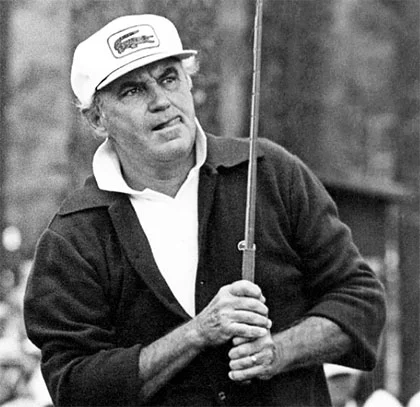
Doug Ford won the first two 500 Festival Opens at Indy.
Ben Hogan ended the 1948 PGA Championship on May 25, with a 7-and-6 victory over Mike Turnesa for his second PGA win. Hogan was 4 up after the first 18 holes at Norwood Hills Country Club in St. Louis, having made six birdies. Hogan had four more birdies in 12 holes of the next round, to easily close out Turnesa in the scheduled 36-hole final.